The short answer
A basement conversion usually adds value to a UK house, but the size of the uplift depends heavily on location and how the space is finished. As a broad guide, agents and surveyors often cite an uplift of around 10–20% of a property's value, and in high-value urban areas, particularly parts of London, a well-executed conversion can add 20% or more. The honest position is that value tracks the local £ per square metre ceiling: in expensive postcodes the new floor area is worth far more than the build, while in lower-value areas the conversion can cost more than it returns. A converted cellar that is habitable, dry, well-lit and properly tanked adds the most; a damp, low-ceilinged storage space adds little.
Whether a basement conversion adds value comes down to local property prices, the quality of the conversion and how the space is used. The sections below set out the typical uplift, the maths behind it, and the conditions that decide whether you see a return.
At a glance
- Typical value uplift~10–20%
- Prime urban areas20%+ possible
- Value driverLocal £/sqft ceiling
- Best returnHabitable, dry, lit space
- Risk areaLower-value postcodes
How much value it typically adds
There is no single national figure, because the uplift is set by how much an extra square metre of floor space is worth in your area. Property commentators and estate agents commonly quote a value increase of around 10–20% for a good basement conversion, with the upper end and beyond seen in high-value city locations where buyers pay a premium for floor area. In a typical suburban or regional home the uplift is usually more modest, and in lower-priced areas it can be small relative to the spend.
The cleanest way to think about it is the local price ceiling: every street has a rough top price that buyers will pay for any house, however large. If your home already sits near that ceiling, adding a basement may not lift the price much; if there is headroom, the extra space can be valued close to the prevailing rate per square metre.
| Scenario | Likely value outcome | Why |
|---|---|---|
| High-value urban postcode | Strong uplift, often 15–20%+ | High £/sqft, floor area scarce |
| Mid-value suburb | Moderate uplift, ~10–15% | Depends on local ceiling |
| Lower-value area | Small or negative return | Build cost can exceed uplift |
| Near the street's price ceiling | Limited uplift | Buyers rarely pay above ceiling |
Indicative outcomes for guidance only. Actual value depends on local prices and quality of work.
The value-per-square-metre logic
Surveyors do not value a basement by what it cost to build; they value the finished home against comparable sales nearby. So the question is really: how much is the extra usable floor area worth at local rates, minus any discount for it being below ground? A bright, tanked basement with good headroom and proper natural light is treated close to normal living space. A dark, low room with limited light is discounted, sometimes heavily.
This is why the same conversion can be a clear win in one postcode and a loss in another. If local houses sell at a high rate per square metre, the new floor area easily justifies a £2,000–£4,000+ per square metre build cost. Where local values are low, the build can cost more than the space adds, and the money is better spent elsewhere.
What makes a basement add the most
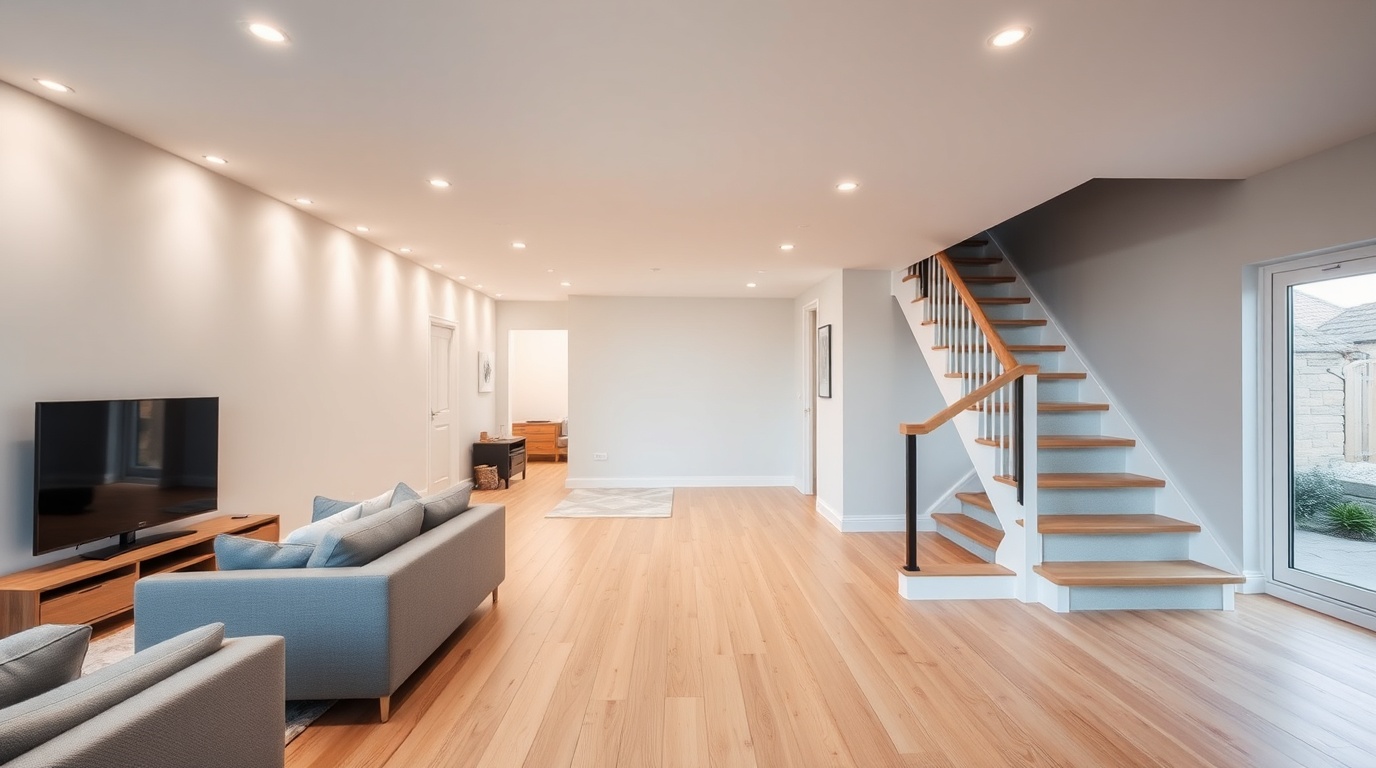
Quality and usability decide how much of the theoretical uplift you capture. The conversions that add real value share several features. Habitability comes first: a room that meets building regulations as living space, with adequate ceiling height (commonly aimed at around 2.1–2.4m), proper damp-proofing or tanking, ventilation and a means of escape, is valued far more than a basic storage cellar.
Natural light matters greatly. A basement with a lightwell, sunken courtyard or large rear glazing reads as a proper room; a windowless box reads as a den or utility space and is discounted. Use also counts: an extra bedroom with an en-suite, a self-contained annexe, or a bright kitchen-diner adds more than a gym or cinema room, because buyers value bedrooms and flexible living space most. Finally, dryness and a sound guarantee reassure surveyors and buyers; a long, insurance-backed tanking warranty supports the valuation, while any sign of damp undermines it.
When it may not pay
Basement conversions are among the most expensive ways to add space, so the cost has to be justified by the value it adds. In lower-value areas, or where a home already commands close to the local ceiling, the spend can exceed the uplift. A poorly finished conversion, a basement with low headroom that could not be lifted economically, or a space with no natural light and limited use, will also under-deliver.
It is worth weighing the alternatives. A loft conversion or rear extension often adds similar or better value at a lower cost per square metre, and with fewer waterproofing and structural risks. A basement makes most sense where there is no other way to add ground-level space, where the local market rewards extra floor area, and where the existing cellar gives you a head start by reducing excavation. Treat the conversion as an investment only after checking that local comparables support it; otherwise, value it as space you want to use rather than money you expect to recover.
Frequently asked questions
How much value does a basement conversion add in the UK?
A good conversion commonly adds around 10–20% of a property's value, and more in high-value urban areas. The exact figure depends on local prices, the quality of the finish and whether the space is habitable and well lit.
Does a basement always add value?
No. In lower-value areas or where a home is already near the street's price ceiling, the build cost can exceed the uplift. Value depends on local price per square metre and the quality of the conversion.
What adds the most value in a basement?
Habitable, dry, well-lit space adds the most, especially an extra bedroom with an en-suite, a self-contained annexe or a bright living area. Natural light from a lightwell and a sound tanking guarantee both support the valuation.
Sources & further reading
- Nationwide House Price Index — value and improvements research
- Checkatrade — basement conversion cost guide
Figures on this page are typical UK ranges drawn from published sources and depend on your specific property. They are guidance, not a quotation.